

AI Giants Pt. 4: Perplexity's $20B Bet Against the Media Industry

This is Part 4 of our AI Giants series, where we examine the successes and shortcomings of today’s largest AI firms. Explore our archive to read Part 1, covering Claude’s recent reliability crisis, Part 2, exploring Google’s path to success in the AI industry, and Part 3, going over OpenAI’s December “Code Red.”
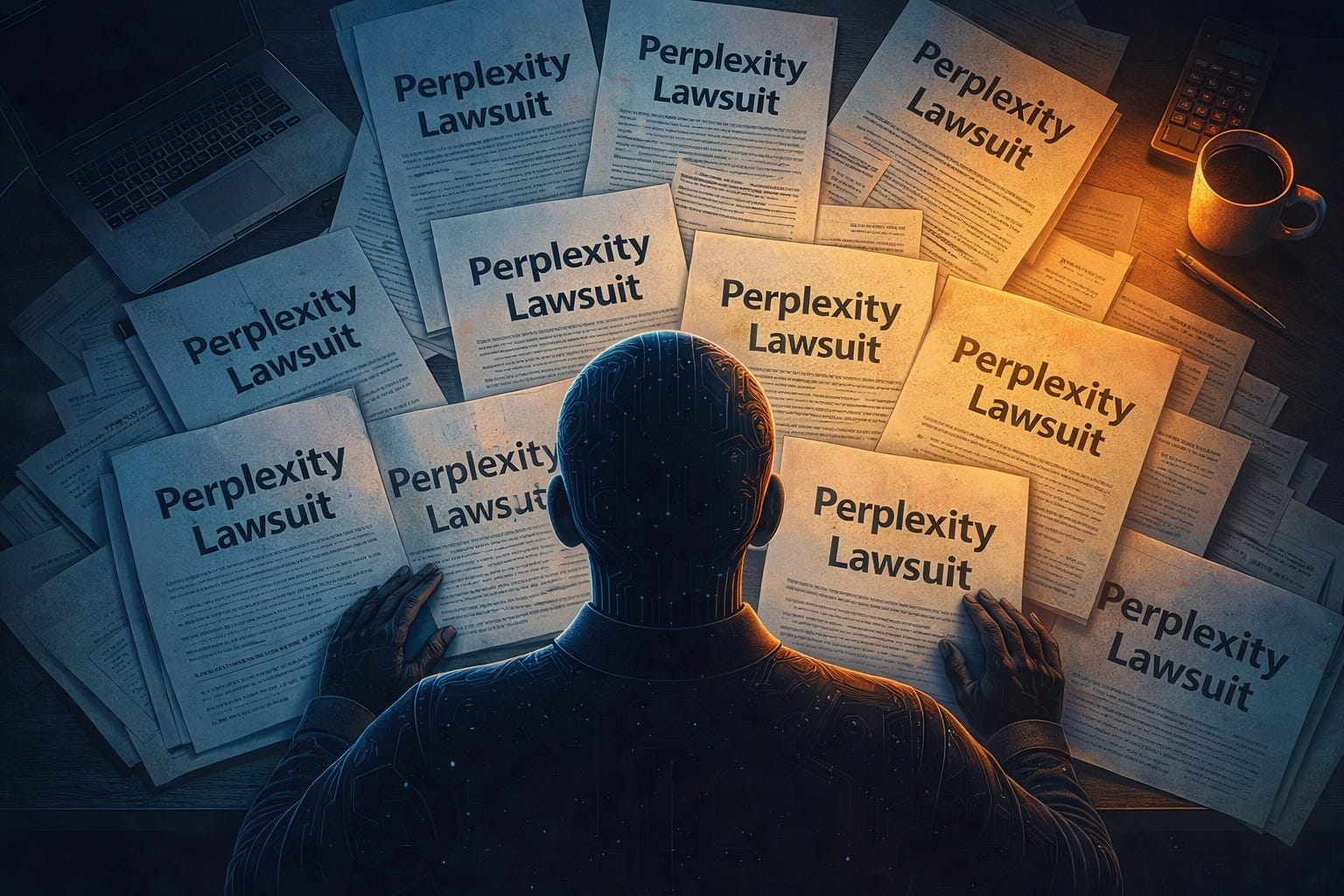
Perplexity AI has emerged as the most formidable challenger to Google’s search dominance in a generation. Achieving a $20 billion valuation in September 2025, Perplexity processes nearly 800 million monthly search queries. But this rise comes with an asterisk; the company now faces copyright lawsuits from The New York Times, News Corp, Reddit, and Encyclopedia Britannica that threaten the very foundations of its business model.
The stakes are enormous. Within two years, CEO Aravind Srinivas has built what he calls an “answer engine” that doesn’t just find links but synthesizes information with cited sources. The company’s partnerships with Snapchat, Deutsche Telekom, and Samsung TV could potentially see the platform reach over a billion users. Yet the same aggressive tactics that fueled this growth, including allegations of ignoring robots.txt files and scraping content without permission, now threaten to define Perplexity’s legacy as either a revolutionary platform or, in the words of News Corp CEO Robert Thomson, a leader in “content kleptocracy.”
18 Months of Staggering Growth
Perplexity’s funding trajectory reads like a Silicon Valley fever dream. The company hit a $1 billion valuation in April 2024, reached $9 billion by December 2024, and crossed $20 billion in September 2025, a twentyfold increase in just 18 months. Total funding now exceeds $1.5 billion from elite backers including Accel, SoftBank, IVP, NVIDIA, and Jeff Bezos.
Revenue has scaled just as impressively. Perplexity crossed $100 million in annual recurring revenue in March 2025, more than quadrupling from roughly $20 million in mid-2024. By late 2025, ARR approached $150-200 million, with management targeting $656 million by the end of 2026. The company processes approximately 30 million queries daily, up from 230 million monthly in August 2024 to 780 million by May 2025, representing 240% growth in under a year.
User metrics reinforce the growth story. The platform serves roughly 22 million monthly active users with exceptionally strong engagement, and a 53% DAU/MAU ratio suggests users return frequently rather than testing and abandoning the product.
The business model remains refreshingly simple with subscriptions being their main revenue driver. With millions of paid subscribers, the $20/month Pro tier generates the bulk of Perplexity’s subscription revenue. Enterprise clients including Stripe, Zoom, Databricks, Snowflake, and HP pay $40 per user monthly, while the company’s API now handles thousands of developers across industries. Perhaps most remarkably, Perplexity maintains this growth with only about 250 employees, yielding revenue-per-employee figures among the highest in the AI sector.
Perplexity’s Expanding Ambitions
Perplexity’s technological moat rests on its Sonar model family, built on Meta’s Llama 3.3 70B and optimized for factual accuracy. The company achieved 1,200 tokens per second through Cerebras inference infrastructure, making responses feel nearly instantaneous. The model lineup now includes Sonar Pro (delivering twice as many citations), Sonar Reasoning (for chain-of-thought tasks), and Sonar Deep Research (conducts dozens of autonomous searches and reads hundreds of sources to produce comprehensive reports in two to four minutes).
The Deep Research feature, launched in February 2025, represents Perplexity’s clearest differentiation from competitors. It achieved 21.1% accuracy on “Humanity’s Last Exam,” a benchmark designed to test frontier capabilities. Pro Search allows users to choose between GPT-5.2, Claude Sonnet 4.5, Gemini 3 Pro, Grok 4, and Perplexity’s own Sonar – multi-model flexibility that neither Google nor OpenAI offers.
But the year’s boldest move was launching Comet, an AI-native browser built on Chromium. Initially available only to $200/month Max subscribers in July, Perplexity made it free globally in October and launched an Android version in November. The browser features a persistent AI assistant that can summarize across all open tabs, handle voice commands, and complete tasks autonomously, with a built-in ad blocker that challenges traditional web monetization. An iOS version remains pending.
The Comet Plus subscription ($5/month) represents Perplexity’s attempt to solve the publisher problem proactively. Partners including CNN, Condé Nast, The Washington Post, Fortune, Le Monde, and Le Figaro receive 80% of subscription revenue when their content is cited or visited through the browser. The company has committed $42.5 million to publisher payments in this program.
The Legal Siege from Publishers
Despite the publisher partnerships, Perplexity faces an unprecedented legal assault. On December 5, 2025, The New York Times filed a federal copyright lawsuit alleging the company “copied, distributed, and displayed millions” of Times articles. The complaint claims Perplexity made 175,000+ access attempts to nytimes.com in August 2025 alone, used disguised user agents to evade detection, and circumvented robots.txt restrictions through third-party crawlers.
The Times lawsuit follows similar actions by News Corp (filed October 2024, survived a motion to dismiss in August 2025), Encyclopedia Britannica and Merriam-Webster (September 2025), Reddit (October 2025), and the Chicago Tribune (December 2025). Japanese publishers including Yomiuri Shimbun and Nikkei have filed suits as well, and are seeking ¥2.2 billion ($15 million) each.
The accusations are specific and damaging. A June 2024 Wired investigation found Perplexity’s IP address accessed Condé Nast properties 822 times in three months despite being blocked. Developer Robb Knight demonstrated that Perplexity summarized his content even after he blocked PerplexityBot via both robots.txt and server-side rules. Most damaging, a Cloudflare investigation in August 2025 documented 3-6 million daily requests from an undeclared “stealth crawler” using user agents designed to impersonate regular Chrome browsers.
Perplexity’s defense rests on fair use and the argument that it doesn’t train foundation models on publisher content, only summarizes and cites it. Head of Communications Jesse Dwyer offered a characteristically defiant response: “Publishers have been suing new tech companies for a hundred years, starting with radio, TV, the internet, social media, and now AI. Fortunately, it’s never worked, or we’d all be talking about this by telegraph.”
The legal outcomes will likely define whether Perplexity’s business model is sustainable. The company’s approach stands in stark contrast to OpenAI, which has struck licensing deals worth hundreds of millions with publishers including News Corp (reportedly $250 million+ over five years), AP, Axel Springer, and Vox Media. The $1.5 billion Anthropic settlement in September 2025—the largest copyright recovery in history—may embolden publishers to pursue aggressive litigation strategies.
Intensifying Competition
Regardless of its momentum, Perplexity remains a small player in search. Google controls 89.7% of global search market share, remaining essentially unchanged despite AI disruption narratives. All AI search platforms combined account for just 0.15% of global traffic. Perplexity captures 15.1% of AI referral traffic compared to ChatGPT’s dominant 77.97%.
Google’s response has been substantive. AI Overviews now appear on 55% of global searches and reach 1.5 billion monthly users. The company launched AI Mode at I/O 2025 with conversational capabilities. Studies have shown AI Overviews reduce click-through rates for top-ranked pages, threatening publishers regardless of which AI platform wins.
ChatGPT Search, launched in October 2024, hasn’t demonstrably hurt Perplexity’s growth. A Datos analysis from October 2024 through January 2025 found no significant impact on Perplexity’s user base. However, ChatGPT’s broader capabilities (coding, creative writing, voice features, plugin ecosystem) give it more surface area to capture users who might otherwise try Perplexity.
Perplexity’s differentiation centers on research depth and source transparency. Its inline citations, academic and SEC filing filters, and multi-model selection offer researchers capabilities ChatGPT lacks. A July 2025 Wordstream study found Google AI Overviews had a 26% error rate on PPC topics versus Perplexity’s 13%. Response times favor Perplexity at under two seconds compared to 3.7 seconds for Google AI Overviews.
The advertising strategy remains uncertain. Perplexity launched “sponsored questions” in November 2024 at $30-60 CPM, which is dramatically higher than industry averages. But by October 2025, the company announced it wasn’t accepting new advertisers, and ad sales head Taz Patel departed in August. Only 12% of consumers trust AI search results “a lot more” than organic results, according to Attest, creating fundamental challenges for ad-supported AI search.
Partnerships Promise a Fruitful 2026
Distribution partnerships represent Perplexity’s most promising growth vector. The $400 million Snapchat deal announced November 5, 2025, will integrate Perplexity into an app with 943 million monthly active users starting early 2026. Snap stock surged over 20% on the announcement.
Telecom partnerships provide additional scale. Deutsche Telekom is launching an AI Phone ($149-999) with Perplexity integrated across ten European markets; Bharti Airtel offers free 12-month Pro subscriptions to its 360 million Indian customers; SK Telecom provides access to 32.5 million South Korean users. Collectively, Perplexity has signed over 25 telecom partnerships potentially reaching 700+ million users.
India has become the company’s largest market by monthly active users. Q2 2025 saw 2.8 million downloads (600% year-over-year growth) and 3.7 million MAUs (640% growth), outpacing ChatGPT’s 350% growth in the country. CEO Srinivas announced a $1 million personal investment and five hours weekly commitment to Indian AI development. However, India’s price sensitivity challenges monetization; ChatGPT generates roughly 100 times more revenue in the market.
Other distribution wins include pre-installation on Motorola Razr phones, integration as a default search option in Firefox, and a Samsung TV app offering free 12-month Pro subscriptions on all 2025 Samsung televisions. The company’s August 2025 bid of $34.5 billion for Google Chrome (more than Perplexity’s own valuation) was rejected but signaled browser ambitions.
Balancing Growth Against Existential Risk
Perplexity occupies a peculiar position: simultaneously one of the most successful AI startups ever built and a company whose core practices face fundamental legal challenges. The next twelve months will likely determine whether it becomes a durable competitor to Google or a cautionary tale about moving fast and breaking things.
The bull case is compelling. Snapchat integration alone could drive massive user acquisition. The Comet browser, if successful, could shift search behavior toward AI-native experiences. Enterprise traction is real, revenue is scaling, and the product genuinely works better than Google for many research tasks. At $150-200 million ARR with 250 employees, unit economics appear strong.
The bear case is equally real. A 38x ARR valuation is historically unsustainable. Multiple lawsuits from major publishers create existential risk. Google and OpenAI have vastly more resources and are actively improving their competing products. The Anthropic settlement precedent suggests publishers can extract enormous damages through litigation. And Perplexity has not yet achieved profitability despite frequent VC infusions.
What makes Perplexity genuinely interesting, and what separates it from the other AI giants in this series, is that its fate hinges on a question that extends far beyond the company itself: Who owns the internet’s knowledge, and what obligations do AI systems have to the humans who created it? The courts, not the market, may ultimately decide whether Perplexity represents the future of search or a cautionary tale about the limits of disruption.
This article was written by Max Kozhevnikov, Data and Software Engineer at Frontier Foundry. Visit his LinkedIn here.
To stay up to date with our work, visit our website, or follow us on LinkedIn, X, and Bluesky. To learn more about the services we offer, please visit our product page.
© 2026 Frontier Foundry. All rights reserved. This article and its contents are the exclusive intellectual property of Frontier Foundry. Unauthorized reproduction, distribution, republication, or derivative use — in whole or in part — without express written permission is strictly prohibited and may result in civil and criminal penalties under U.S. and international copyright law.
Frontier Foundry builds deterministic, secured AI for financial services, life sciences, and U.S. federal law enforcement. Our work spans AI governance aligned to the NIST AI RMF and the EU AI Act, post-quantum cryptographic agility, and privacy-first deployment patterns for organizations where getting the answer wrong carries regulatory, safety, or reputational consequences. Founded and led by Sultan Meghji — former inaugural Chief Innovation Officer of the FDIC.