

Emerging Technologies for Community Banks
From Strategic Context to Applied Delivery: A Resource Guide for Community Bankers

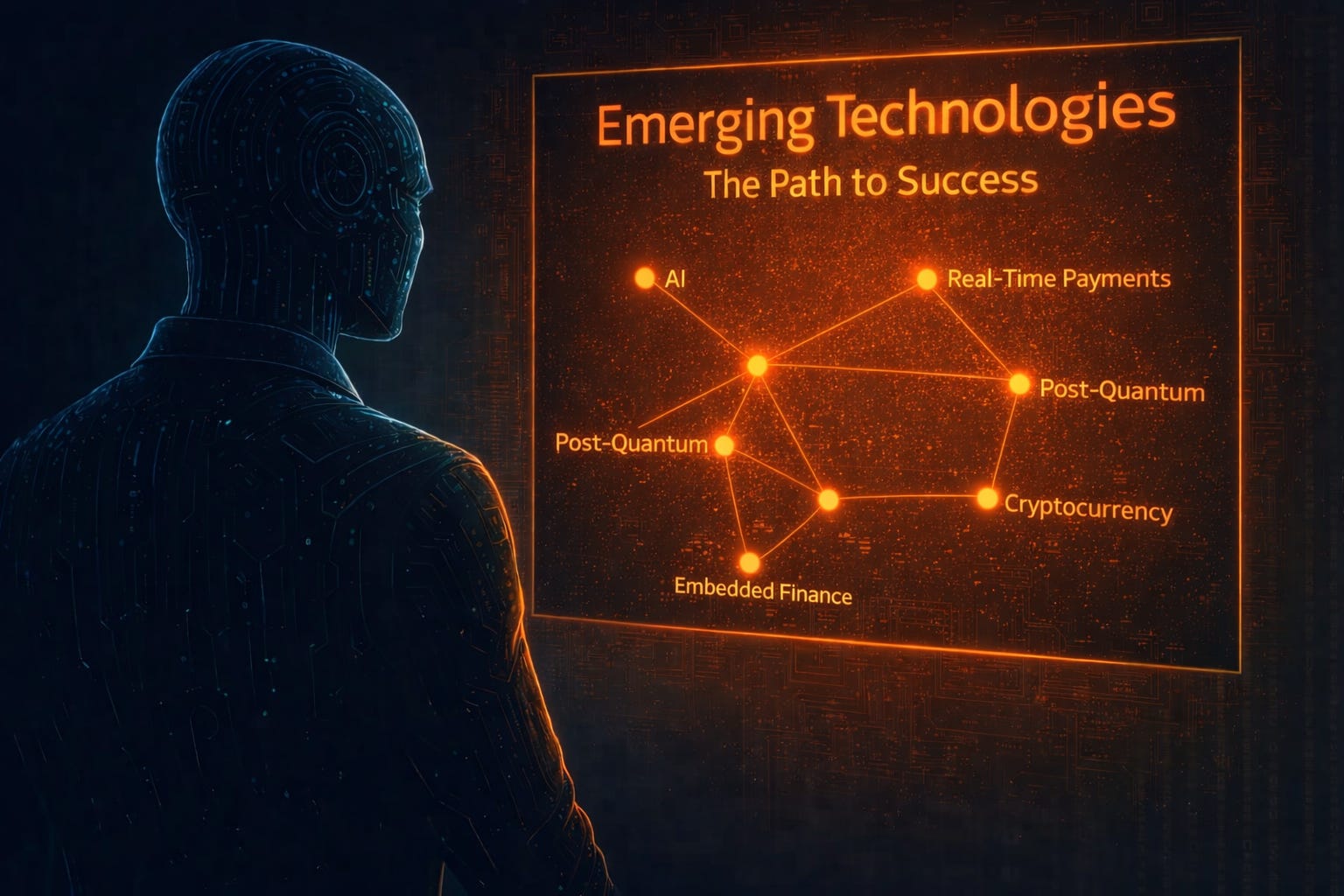
The banking industry is experiencing its most significant technological transformation in decades. For community banks, this presents both existential risks and unprecedented opportunities. This article summarizes key frontier technologies in the industry, providing actionable context and resources for bank leadership and boards.
The core message is straightforward: your larger competitors are already deploying these technologies at scale. Community banks that move strategically now will capture competitive advantages. Those that wait will find themselves playing catch-up in an increasingly digital marketplace.
1. Artificial Intelligence in Banking Operations
The Compliance Opportunity
Bank Secrecy Act and Anti-Money Laundering (BSA/AML) compliance represents one of the most significant cost centers for community banks. According to the Conference of State Bank Supervisors, community bankers report that 24.9% of their compliance costs are attributable to anti-money laundering efforts. Industry estimates suggest U.S. financial institutions spent $59 billion on BSA/AML compliance in 2023. The OCC has begun streamlining BSA/AML examination procedures for community banks, with new procedures effective February 2026. However, the fundamental compliance burden remains. AI-powered transaction monitoring, suspicious activity detection, and automated reporting represent the lowest-risk, highest-ROI entry point for AI adoption.
Key Considerations for AI Implementation
Explainability: Regulators are shifting from “prove you’re compliant” to “prove your AI is explainable.” Any AI system deployed for compliance must be able to demonstrate its decision-making logic.
Vendor Due Diligence: Most “AI solutions” marketed to community banks are repackaged rules engines with chatbot interfaces. Demand to see model architecture and validation methodologies before procurement.
Board Literacy: Your board needs AI literacy immediately. Regulators will ask questions, and “we trust our vendor” is not an acceptable answer.
2. The Legacy Technology Gap
Many legacy core banking providers have not kept pace with technological advancement. Community banks often rely on systems designed in the 2010s or earlier, now marketed with superficial updates. Meanwhile, fintech competitors build natively on modern cloud infrastructure with API-first architectures.
The Commoditization of Software
“Vibe coding”—the use of AI coding assistants to rapidly build functional software—is fundamentally changing the build-versus-buy calculus. A competent operator can now build in a weekend what previously required $500,000 and six months of development. This democratization of software development means custom solutions are increasingly viable for institutions that previously could only afford off-the-shelf products.
Strategic Implication: Evaluate whether your current technology partnerships are delivering genuine innovation or simply annual maintenance fees on aging systems. Consider whether targeted custom development might address specific pain points more effectively than waiting for vendor roadmap items.
3. Real-Time Payments: FedNow and the Velocity
Imperative
The Federal Reserve’s FedNow Service has reached significant milestones since its July 2023 launch. As of early 2025, more than 1,400 financial institutions participate in FedNow, with community banks and credit unions making up more than 95% of participants. Transaction volumes grew 1,200% year-over-year through early 2025.
Market Context
The Clearing House’s competing RTP network processed 343 million transactions valued at $246 billion in 2024. While FedNow’s volumes remain smaller, adoption is accelerating rapidly. Use cases gaining traction include instant payroll, digital wallet funding, real estate transactions, and insurance payouts.
Risk Considerations
Real-time payments eliminate the traditional window for fraud detection and returns. With FedNow and RTP, banks have one opportunity to screen for proper authorization and fraud before funds move irrevocably. This velocity creates both fraud risk and opportunity for banks that can move intelligently fast.
Sources: Federal Reserve Financial Services, The Clearing House, American Banker (February 2025)
4. Evolving Cybersecurity Threats
AI-Powered Fraud: Deepfakes and Voice Cloning
Deepfake and voice cloning attacks represent a rapidly escalating threat. In February 2024, a finance worker at engineering firm Arup was tricked into transferring $25 million after a video call with what appeared to be the company’s CFO and other executives— all of whom were AI-generated deepfakes. Deloitte’s Center for Financial Services predicts that generative AI could enable fraud losses to reach $40 billion in the United States by 2027, up from $12.3 billion in 2023. One report found deepfake incidents increased 700% in fintech in 2023 alone. Voice cloning technology now requires as little as three seconds of audio to create a convincing voice clone. A 2024 McAfee study found that 1 in 4 adults have experienced an AI voice scam.
Defensive Measures
Multi-Person Authorization: Require multiple approvals for any financial transaction over defined thresholds, regardless of who appears to be requesting it.
Out-of-Band Verification: Establish protocols requiring verification through separate, pre-established communication channels for unusual requests.
Employee Training: Regular training sessions about deepfake threats, including examples of recent attacks and practice identifying suspicious communications.
Sources: Deloitte Center for Financial Services, The Wall Street Journal, McAfee (2024)
5. Post-Quantum Cryptography: Preparing for the Quantum Threat
Quantum computers, when sufficiently advanced, will be capable of breaking current encryption standards including RSA and elliptic curve cryptography—the foundations of today’s secure communications. While cryptographically relevant quantum computers may be a decade or more away, the “harvest now, decrypt later” threat is immediate: adversaries can collect encrypted data today and decrypt it when quantum capability becomes available.
NIST Post-Quantum Standards
In August 2024, the National Institute of Standards and Technology (NIST) released its first three post-quantum cryptography standards: FIPS 203 (ML-KEM for key encapsulation), FIPS 204 (ML-DSA for digital signatures), and FIPS 205 (SLH-DSA for stateless hash-based signatures). NIST’s transition timeline calls for deprecating quantum-vulnerable algorithms by 2035, with high-risk systems transitioning earlier.
Action Items for Community Banks
Begin asking your technology vendors about their post-quantum cryptography roadmaps. Inventory systems and data that rely on vulnerable cryptographic algorithms. Prioritize transition planning for systems protecting data with long-term sensitivity.
Source: NIST Post-Quantum Cryptography Standardization (August 2024), Department of Homeland Security
6. Cryptocurrency and Digital Assets
The regulatory posture toward cryptocurrency has shifted significantly in 2025. The OCC has issued multiple interpretive letters clarifying that national banks may provide crypto-asset custody services, engage in certain stablecoin activities, and participate in blockchain networks—without requiring prior supervisory non-objection.
Recent Regulatory Developments
OCC Interpretive Letter 1183 (March 2025): Confirmed that crypto-asset custody, stablecoin activities, and distributed ledger participation are permissible for national banks and federal savings associations.
OCC Interpretive Letter 1184 (May 2025): Clarified that banks may buy and sell assets held in custody at customer direction and may outsource crypto-asset activities to third parties with appropriate risk management.
National Trust Bank Charters (December 2025): The OCC granted conditional approval to several crypto-native firms including Ripple, BitGo, Paxos, and Circle to establish national trust banks.
Strategic Consideration
Your customers are already using cryptocurrency whether you offer services or not. The question is whether you will capture that relationship or cede it to Coinbase, PayPal, or fintech competitors.
7. Embedded Finance and the Invisible Bank
Embedded finance—financial services integrated seamlessly into non-financial platforms—represents a fundamental shift in how consumers access banking services. Every time a customer gets financing through Shopify, pays through Apple Pay, or obtains insurance at checkout, that’s a banking relationship your institution never had a chance to compete for.
Market Scale
The embedded finance market is projected to reach over $450 billion by 2031, with a compound annual growth rate around 24%. A recent study found that 94% of mid-to-large enterprises plan to increase their embedded finance investments, with 76% expecting upgrades within 12 months.
Banking-as-a-Service Opportunity
For community banks, Banking-as-a-Service (BaaS) offers a path to participate in embedded finance. By leveraging regulatory licenses and core infrastructure, banks can become foundational partners for FinTechs and brands seeking to offer financial products. This requires investment in API infrastructure and partnership capabilities but enables access to customer segments that would otherwise be unreachable.
Sources: Mordor Intelligence, McKinsey, Green Dot/PYMNTS (2025)
8. Community Bank Competitive Advantages
Despite the challenges, community banks possess distinct advantages that technology cannot easily replicate:
Relationship Context: You actually know your customers. Your AI can be trained on real relationship context, not just transaction data. Decades of lending decisions, customer behavior patterns, and local market knowledge represent a data moat that big tech companies cannot replicate.
Regulatory Trust: Your charter and regulatory relationships provide a foundation that FinTechs spend years and millions trying to establish or work around.
Talent Flexibility: Remote work has fundamentally changed the talent market. You’re no longer competing with Charlotte or Atlanta for talent if you’re willing to hire the sharp compliance analyst who doesn’t want to relocate. Small banks can punch above their weight here.
9. Implementation Framework
Strategic Delivery Approach
Pilot Small: Pick one process, one branch, one use case. BSA/AML automation is often the ideal starting point given clear ROI and regulatory alignment.
Prove Value: Measure everything. Document efficiency gains, false positive reductions, and time savings with specificity.
Then Scale: Expand based on proven results, not vendor promises.
Vendor Selection Criteria
Partner with vendors who transfer knowledge, not just software licenses. Ask for model architecture documentation, validation methodologies, and regulatory compliance evidence. Demand references from institutions of similar size and complexity. The compliance officer of 2030 won’t be replaced by AI—they’ll be the person who knows how to direct AI. Invest in upskilling your people now, not just your technology.
The banking industry’s ongoing technological transformation has created great opportunities for community banks to close the gap between their national competitors and offer their customers rivaling features and capabilities. Those that fail to adopt these new technologies put themselves at risk of falling behind in an increasingly complex technological landscape.
The window for strategic action is open, but it won’t stay open long.
This article was written by Sultan Meghji, CEO of Frontier Foundry. Visit his LinkedIn here.
To stay up to date with our work, visit our website, or follow us on LinkedIn, X, and Bluesky. To learn more about the services we offer, please visit our product page.
© 2026 Frontier Foundry. All rights reserved. This article and its contents are the exclusive intellectual property of Frontier Foundry. Unauthorized reproduction, distribution, republication, or derivative use — in whole or in part — without express written permission is strictly prohibited and may result in civil and criminal penalties under U.S. and international copyright law.
Frontier Foundry builds deterministic, secured AI for financial services, life sciences, and U.S. federal law enforcement. Our work spans AI governance aligned to the NIST AI RMF and the EU AI Act, post-quantum cryptographic agility, and privacy-first deployment patterns for organizations where getting the answer wrong carries regulatory, safety, or reputational consequences. Founded and led by Sultan Meghji — former inaugural Chief Innovation Officer of the FDIC.