

Software Will Be Free. So Why Are Banks and Hospitals Still Paying Like It's 1999?

The cost of building intelligent software is collapsing toward zero. But in the two sectors that matter most to the American economy, trillion-dollar incumbents have built moats not out of technology, but out of fear. AI can now write code, interpret regulations, analyze medical records, and reason through complex compliance workflows. What once required a 200-person engineering team and $50 million can be prototyped by a small team in weeks. The marginal cost of software intelligence is approaching zero.
We are entering an era where the barrier to software development is functionally nonexistent.
But walk into any mid-size bank or regional hospital system in America and you’ll find something that defies this reality: enterprise software contracts that cost tens of millions of dollars a year and are locked in for a decade, running on architectures designed before the iPhone existed. And nobody, not the CEO, not the CIO, not the board, is willing to touch them.
This issue lies not within the technology, but within the existing power structure. And understanding it requires understanding what’s really at stake.
Two Sectors, One Quarter of the Economy
Healthcare and financial services are the backbone of the American economy. Together, they account for more than 25% of the U.S. GDP, driving roughly $7 trillion in annual economic activity. Healthcare alone represents nearly 18% of GDP at $4.8 trillion, making it the single largest sector. Financial services, including banking, capital markets, insurance, and asset management, contributes another 8% or so.
Between them, these sectors employ close to 30 million Americans. Healthcare is the nation’s largest employer at 22 million workers. Financial services adds another 7 million, with average compensation roughly double the national average.
These are the sectors that touch every American, every day. And they are both drowning in legacy technology costs that no longer reflect the value being delivered.
The Moat Isn’t Technology. It’s Fear.
Companies like Epic in healthcare and FIS, Fiserv, and Jack Henry in banking haven’t survived because their technology is the best available. They’ve survived because they’ve constructed something far more durable than good software: structural lock-in across multiple reinforcing dimensions.
The data is held hostage. Epic holds patient records in proprietary formats, and core banking platforms hold decades of transaction histories, customer records, and regulatory reporting infrastructure. Migration is both expensive and risky. A botched core banking conversion can kill a bank, while a botched EHR migration can harm patients. The switching cost exists as an existential threat, not just a budget line item.
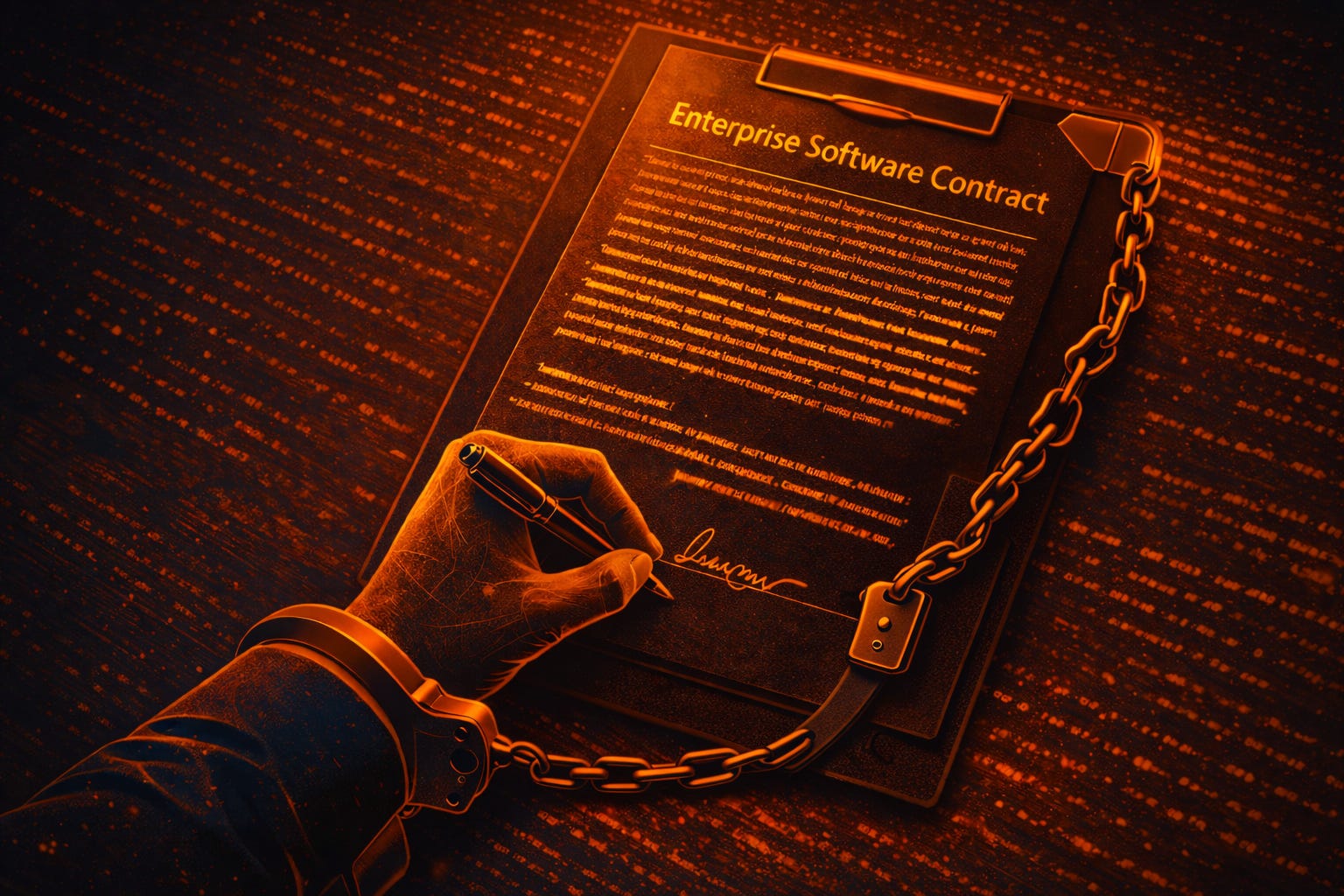
Contracts are designed as quicksand. Multi-year licensing deals with massive early termination penalties and bundled service packages where you can’t extract one module without destabilizing the rest keep customers locked-in for years. Professional services revenue that dwarfs the software license, with Epic implementations routinely costing 3 to 5 times the license itself. These contracts serve as economic weapons designed to make leaving more expensive than staying.
The regulators have been co-opted. This is the part most people outside these industries don’t understand. These vendors have embedded themselves into the regulatory examination process itself. Examiners know what Epic output looks like. They know FIS report formats. When a bank tells an OCC examiner “we run on FIS,” that’s shorthand for “you don’t need to dig deeper into our systems.” Choosing something unfamiliar introduces regulatory uncertainty, and in regulated industries, uncertainty is the one thing no executive will tolerate.
The institution has been reprogrammed. Thousands of employees are trained on these systems, with entire workflows being built around their specific quirks and limitations. The CFO who signed the original deal is still on the board. The IT director’s entire career trajectory is staked on the platform choice they made in 2014. Changing systems doesn’t just mean changing software. It means telling a lot of powerful people they were wrong.
The Paradox: Software Is Free, Switching Is Not
Here’s the tension at the heart of this moment. AI makes it trivially cheap to build software that replicates much of what Epic or FIS does in critical functional areas. Compliance automation, document processing, risk scoring, clinical decision support — these capabilities can be constructed with modern AI tools at a fraction of what incumbents charge.
But AI doesn’t solve the switching cost problem. It doesn’t solve the regulatory comfort problem. It doesn’t solve the career-risk problem.
A bank CEO isn’t paying FIS $20 million a year because they believe FIS is worth $20 million. They’re paying because the perceived cost of being wrong about an alternative is $200 million in regulatory penalties, operational disruption, reputational damage, and personal career risk.
When so much is on the line for these decision makers, the software is no longer the product. The insurance policy is.
This is why the “software will be free” thesis, taken at face value, misses something important about these markets. You can build a better mousetrap. You can build it for a tenth of the cost. But if the building is rigged so that replacing the old mousetrap might bring down a load-bearing wall, nobody will touch it.
Where the Wall Cracks
But here’s where it gets interesting. The winning strategy was never “rip out Epic” or “rip out FIS.” That’s a frontal assault on a fortified position, and it will fail for all the structural reasons above.
The winning strategy is building an intelligence layer that sits on top of, or alongside, the legacy stack. The AI doesn’t replace the system of record. It makes the system of record progressively less relevant. This is already happening. Banks are keeping their cores but wrapping AI around them for BSA/AML compliance, fraud detection, and regulatory reporting, while hospitals are keeping Epic but layering AI for clinical decision support, medical coding, and prior authorization. The legacy system quietly becomes a dumb database while the intelligence that actually creates value migrates to the new layer.
The economic tipping point arrives when institutions realize they’re paying $20 million a year for a database. That’s when the renegotiation happens. Not a rip-and-replace revolution, but a power shift. The value migrates from the incumbent’s proprietary platform to the AI layer above it, and suddenly the licensing leverage flips.
There’s a second accelerant: regulatory modernization. As regulators themselves adopt AI-native tools and begin expecting AI-driven compliance outputs, the “examiner familiarity” moat starts to erode. When the OCC or CMS starts evaluating institutions based on the quality of their AI-generated risk analysis rather than the brand name of their core platform, the game changes fundamentally.
The Trillion-Dollar Question
Healthcare and financial services together represent more than $7 trillion in annual economic activity. A conservative estimate of the “legacy technology tax” (the premium institutions pay above the actual value delivered) is in the hundreds of billions of dollars annually, sustained by lock-in rather than innovation. That’s a liberation movement waiting to happen. The question isn’t whether software will be free. It already functionally is.
As the price of software engineering continues to fall, it only becomes a matter of time before the institutions paying for it realize that what they’re really paying for is a habit.
And habits, unlike contracts, can be broken.
This article was written by Sultan Meghji, CEO of Frontier Foundry and former Chief Innovation Officer at the FDIC. Visit his LinkedIn here.
To stay up to date with our work, visit our website, or follow us on LinkedIn, X, and Bluesky. To learn more about the services we offer, please visit our product page.
© 2026 Frontier Foundry. All rights reserved. This article and its contents are the exclusive intellectual property of Frontier Foundry. Unauthorized reproduction, distribution, republication, or derivative use — in whole or in part — without express written permission is strictly prohibited and may result in civil and criminal penalties under U.S. and international copyright law.
Frontier Foundry builds deterministic, secured AI for financial services, life sciences, and U.S. federal law enforcement. Our work spans AI governance aligned to the NIST AI RMF and the EU AI Act, post-quantum cryptographic agility, and privacy-first deployment patterns for organizations where getting the answer wrong carries regulatory, safety, or reputational consequences. Founded and led by Sultan Meghji — former inaugural Chief Innovation Officer of the FDIC.